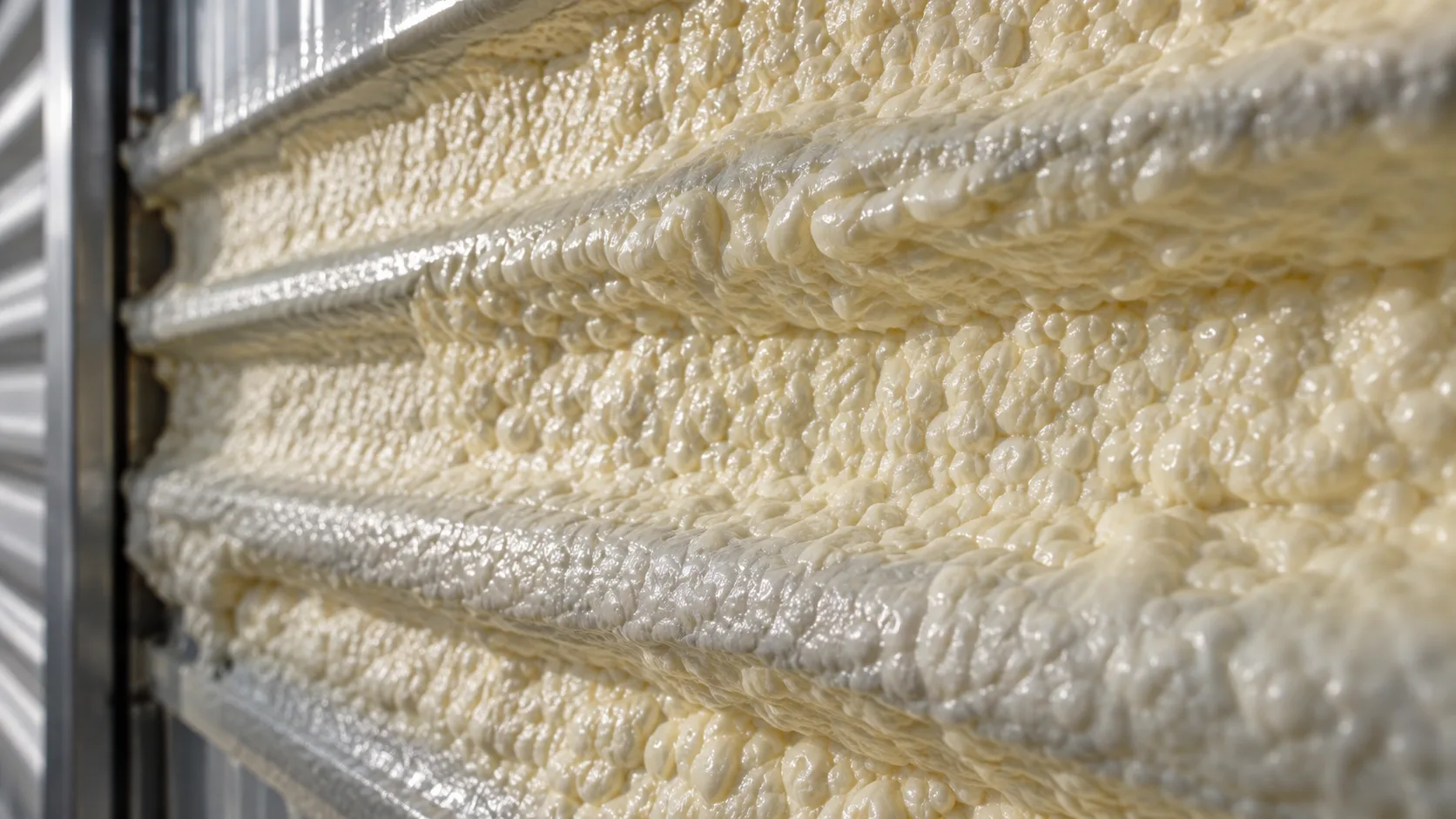
Air barrier
A material that stops air from leaking through walls and roofs. Closed-cell spray foam typically acts as an air barrier at about 1 inch and open-cell at about 3.5 inches, depending on the product. In a metal building, sealing laps, eaves and ribs keeps humid outside air from reaching cold steel.
Barndominium (barndo)
A home built inside a metal building shell, usually with living space on one side and a shop or garage on the other. Barndos often get different foam thickness on each side. See barndominium spray foam.
Climate zone 2A
The energy-code climate zone for Houston, Beaumont, Conroe, Liberty County and the rest of Southeast Texas, plus all of Louisiana. The “A” means moist: hot, humid summers and high dew points, which is why condensation control matters so much on metal buildings here.
Closed-cell spray foam
A dense spray foam (about 2 lb per cubic foot), typically about R-6 to R-7 per inch depending on the product. It doesn’t absorb water, becomes a Class II vapor retarder at roughly 1–2 inches, and is the foam we normally recommend against steel. Compare it in closed cell vs open cell on metal buildings.
Condensation (“sweating”)
Water that forms on the inside of metal panels when the steel is colder than the dew point of the air touching it, like a cold glass in summer. It drips, rusts fasteners and soaks what is stored below. Continuous closed-cell coverage keeps humid air off the steel.
Dew point
The temperature at which moisture in the air turns into water. Southeast Texas has some of the highest dew points in the country, so metal roofs and walls cool past it easily on clear nights or in air-conditioned buildings — the root cause of sweating steel.
Eave height
The height of the side walls, from the slab to where the roof starts. It’s the “H” in the length × width × height we ask for, and it drives the wall square footage. Send yours for a quote.
Girt
A horizontal steel member running along the walls of a metal building that the wall panels attach to. Girts left bare can still sweat in a humid building, so good spray foam work covers them along with the panels.
Ignition barrier
A lighter protective covering allowed over spray foam in spaces entered only for service, such as some attics and crawl spaces. It is less protective than a thermal barrier, and what qualifies depends on the code and the specific foam product.
Intumescent coating
A paint-like coating, such as DC315, that swells when heated and can serve as a code-approved thermal or ignition barrier over spray foam. It only counts when used with the specific foam products and thickness listed in its evaluation report.
Lift (pass)
One layer of spray foam applied in a single pass. Closed-cell foam is applied in lifts that follow the manufacturer’s maximum thickness and cooling time. Spraying too thick in one pass can cause cracking, splitting or poor cell structure.
Off-ratio foam
Spray foam where the two chemical parts were not mixed in the right proportion or at the right temperature. It can shrink, crack, pull away from the surface or leave a lasting odor. Calibrated equipment, correct temperatures and careful application prevent it.
Open-cell spray foam
A soft, light spray foam, about 0.5 lb per cubic foot, typically about R-3.6 to R-3.8 per inch depending on the product. It costs less per board foot but lets water vapor pass through, which is a problem against cold steel in humid Southeast Texas.
Perm
The unit for how easily water vapor passes through a material. Lower numbers mean less vapor gets through. Closed-cell foam drops below 1 perm at roughly 1 to 2 inches depending on the product; open-cell foam stays well above 1 perm.
Pre-engineered metal building (PEMB)
A steel building designed and fabricated as a kit of frames, purlins, girts and panels, then erected on site. Check your manufacturer’s panel warranty language before spraying — see spray foam, rust and warranties.
Purlin
A horizontal steel member running along the roof of a metal building that the roof panels attach to. Like girts, purlins and the screw tips through them can sweat if left bare, so they should be covered for continuous foam coverage.
R-value
A measure of how well insulation resists heat flow. The higher the R-value, the greater the insulating power. It depends on foam type and thickness — 2 inches of closed-cell foam is roughly R-12 to R-14 depending on the product. See how thick spray foam should be.
Roof pitch
How steep a roof is, written as rise over 12 inches of run. Many metal buildings are 1:12 or 3:12. Steeper pitch adds a little roof area and taller gable triangles, which slightly increases the square footage to spray.
Thermal barrier
A covering required by code to separate spray foam from occupied space, most commonly ½-inch drywall or a listed intumescent coating. Exposed foam in a lived-in or worked-in space normally needs one; we tell you what applies before we spray.
Vapor retarder
A layer that slows water vapor. Code classes: Class I is 0.1 perm or less, Class II is over 0.1 to 1.0 perm, Class III is over 1.0 to 10 perm. Closed-cell spray foam is a Class II vapor retarder at about 1 to 2 inches, depending on the product.
R-values are typical ranges for the foam type and thickness stated and vary by product. The higher the R-value, the greater the insulating power. Ask your seller for the fact sheet on R-values.