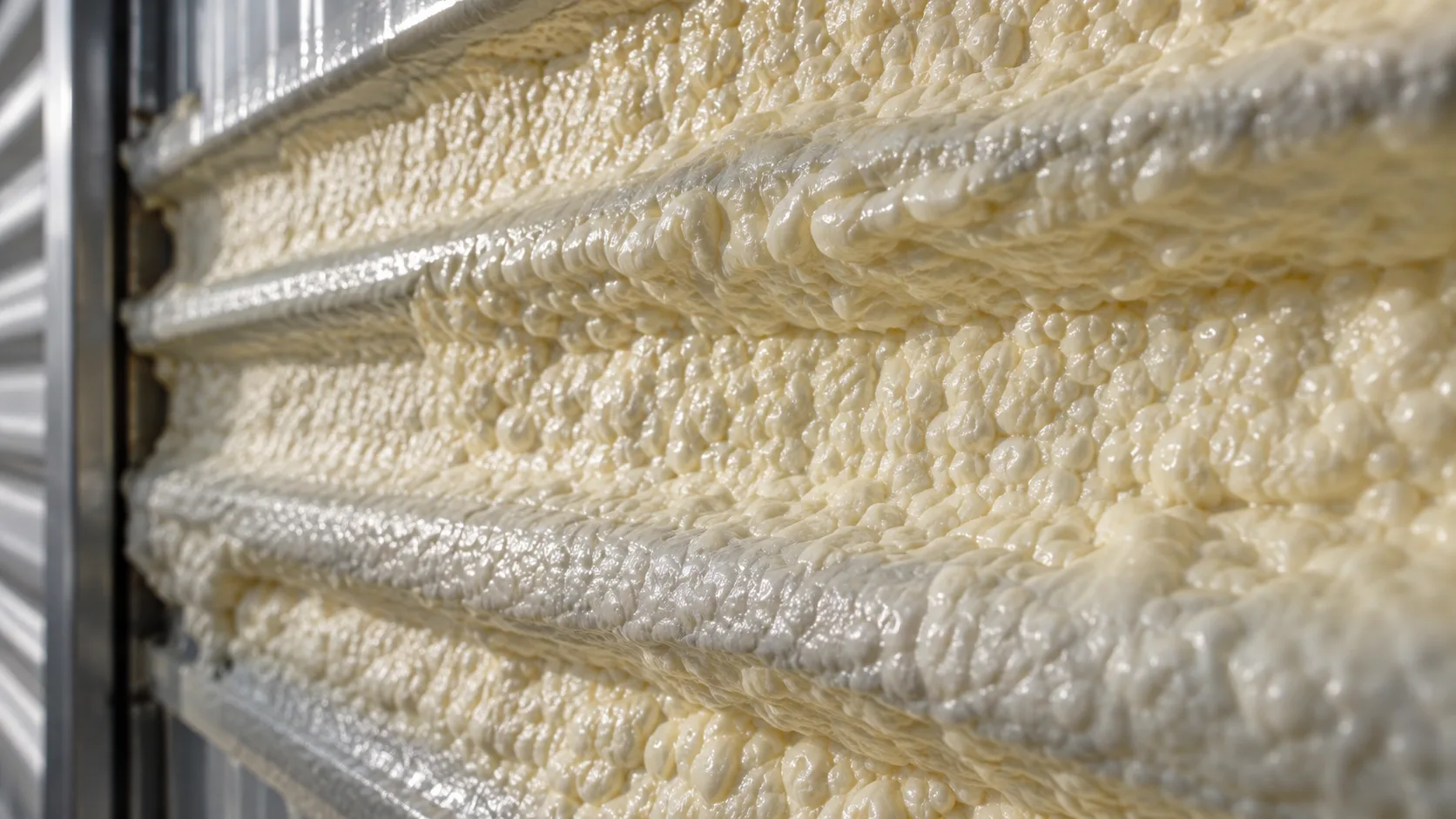
Why do metal buildings sweat in the first place?
Steel panels change temperature fast. On a clear night, or once you air-condition the inside, the steel can get colder than the dew point of the air touching it. When that happens, water vapor in the air turns to liquid on the steel, the same way a glass of iced tea sweats on a summer porch.
Southeast Texas makes this worse. Houston-area summer mornings regularly hit relative humidity above 90 percent, and the Golden Triangle around Beaumont and Port Arthur is some of the wettest air in the state. A bare metal roof here can "rain" inside: drips on your truck, rust on the purlins, and mildew on anything stored underneath.
So when you insulate a metal building, you're solving two problems at once: heat, and moisture reaching the cold steel. That second problem is where closed-cell and open-cell foam split apart.
The two foams, side by side
| Closed-cell foam | Open-cell foam | |
|---|---|---|
| Density | About 2 lb per cubic foot (rigid) | About 0.5 lb per cubic foot (soft, spongy) |
| R-value per inch | About R-6 to R-7.4 per inch, depending on product | About R-3.6 to R-3.8 per inch |
| Vapor control | Class II vapor retarder at about 1 to 2 inches, depending on product | Vapor-open (Class III) |
| Liquid water | Hydrophobic, does not soak up water | Can absorb and hold water |
| Air sealing | Air barrier at about 1 inch (product-specific) | Air barrier at about 3.5 inches (product-specific) |
| Flood rating | Listed acceptable in FEMA Technical Bulletin 2 (2025) | Listed unacceptable |
| Cost per board foot | Higher | Lower |
Sources for these figures include the U.S. Department of Energy's Building America spray foam guide, manufacturer technical data sheets, and FEMA Technical Bulletin 2 (2025).
Why is open cell a poor match for bare steel?
Open-cell foam is great at what it's designed for: filling cavities in houses and blocking air. But it is vapor-open. Humid air can work its way through the foam, reach the cold steel behind it, and condense right there, where you can't see it. Because open-cell foam also holds liquid water, that moisture can sit against the panel.
Metal building suppliers say the same thing in plain terms: open-cell foam lets moisture pass, so you can end up with condensation on the underside of the roof steel. And building science research on open-cell foam under roof decks in hot, humid climates has documented moisture problems in the material behind the foam.
Why closed cell is the usual choice
For the metal buildings we work on, we normally recommend closed-cell foam. Here's why:
- It puts insulation and vapor control in one layer. Sprayed directly on the panel, it bonds to the steel and keeps humid inside air from reaching it.
- More R-value per inch. 2 inches of closed-cell foam is roughly R-12 to R-14.8, depending on the product. To get about R-13 from open-cell foam takes about 3.5 inches.
- It doesn't soak up water. If a roof screw leaks or a storm blows rain in, closed-cell foam won't act like a sponge.
- It's rigid. It holds its shape on vertical walls and overhead panels.
The honest caveats
Closed-cell foam lowers condensation risk a lot, but only when it's done right:
- Coverage has to be continuous. Purlins, girts and the screw tips that poke through the panels need to be covered. Any bare steel inside a humid building can still reach the dew point and sweat.
- Thickness has to reach the vapor-retarder range for the specific product, usually 1 to 2 inches.
- High-moisture uses still need ventilation. Livestock barns, wash bays, or a shop with an unvented propane heater put a lot of water in the air. Foam doesn't replace ventilation or a dehumidifier.
- Fix roof leaks first. Foam over the panels makes leaks harder to spot. Our post on spray foam, rust and warranties covers this.
When does a hybrid of closed and open cell make sense?
A hybrid puts a layer of closed-cell foam against the steel first (thick enough to work as the vapor retarder, typically 1 to 2 inches depending on product), then adds open-cell foam on top for cheaper R-value. It shows up most in the living side of a barndominium, where you want a lot of insulation under the roof but don't want to pay closed-cell prices for all of it.
For a straight shop or barn, a hybrid usually isn't worth the complexity. Closed-cell all the way through is simpler and handles moisture the same everywhere.
Signs your building is already sweating
If your building is up and you're not sure whether condensation is a problem, look for these:
- Drips on vehicles, tools or the slab on cool mornings, even when it hasn't rained
- Rust streaks or spots on purlins, girts and the underside of roof panels
- Wet or stained fiberglass, or sagging vinyl facing between purlins
- Mildew smell or mold spots on stored boxes, wood or furniture
- Puddles along the walls that line up with panel seams rather than with a leak above
Condensation usually shows up after a cool, clear night following a humid day, or as soon as you start air-conditioning the building. Leaks show up after rain. If drips appear on dry, clear mornings, it's almost certainly condensation.
What this means for a barndominium
A barndo has two kinds of space under one steel roof. On the shop side, the job is mostly keeping the steel dry and the heat down, and closed-cell foam against the panels does both. On the living side, you're air-conditioning a house inside a steel shell, which makes the steel colder and the condensation risk higher. That's where a closed-cell layer against the steel matters most, whether it's closed-cell all the way or a hybrid with open-cell on top. See our barndominium spray foam cost guide for how that breaks down.
Questions to ask any contractor
- Which foam product are you using, and can I see its data sheet?
- How many inches on the walls and on the roof?
- At that thickness, is the foam a Class II vapor retarder?
- Will you cover the purlins, girts and screw tips?
- How many passes, and what's the maximum thickness per pass for this product?
- What thermal barrier will I need afterward, if any?
A contractor who answers those clearly is a contractor who knows metal buildings.
What about fiberglass and bubble wrap?
Vinyl-faced fiberglass rolls are cheap and usually go in while the building is being erected. They work when the facing stays intact and the tabs stay sealed, but they're hard to add later and the fiberglass gets compressed over the purlins. Reflective "bubble" products reflect radiant heat but don't stop heat conduction the way insulation does, and federal rules don't allow them to claim a standalone R-value. If you already have one of these and the building still sweats, closed-cell foam is a common fix.
How do the two foams compare on a real building?
Take a 30x40 shop with 12-foot walls: about 2,922 square feet of wall and roof. Suppose you want roughly R-13 everywhere.
- Closed-cell: about 2 inches gets you roughly R-12 to R-14.8, depending on product. That's about 5,843 board feet.
- Open-cell: about 3.5 inches gets you roughly R-12.6 to R-13.3. That's about 10,227 board feet.
Open-cell is cheaper per board foot, but you need about 75 percent more of it to reach a similar R-value, so the gap in total price is smaller than the per-board-foot numbers suggest. Then add the cost of what happens if the steel behind it sweats. On bare metal in Southeast Texas, that math usually favors closed-cell.
Does closed-cell foam smell or off-gas?
Properly applied spray foam cures within a day or so. Most manufacturers suggest staying out of the building for about 24 hours after a professional high-pressure application, with ventilation running, and some products list different times. Persistent odor, shrinking or cracking are usually signs of foam that wasn't mixed or applied correctly: wrong temperatures, off-ratio chemicals, or passes sprayed too thick. That's why equipment, chemical handling and application matter as much as the foam itself.
The bottom line
Open-cell foam is a good product in the wrong place on bare steel in a Gulf Coast climate. Closed-cell foam costs more per board foot but handles heat, humid air and stray water in one layer. That's why it's what we normally recommend on metal buildings, and on the shell of most barndominiums. To see how thickness changes the price, read how thick spray foam should be on a metal building.