
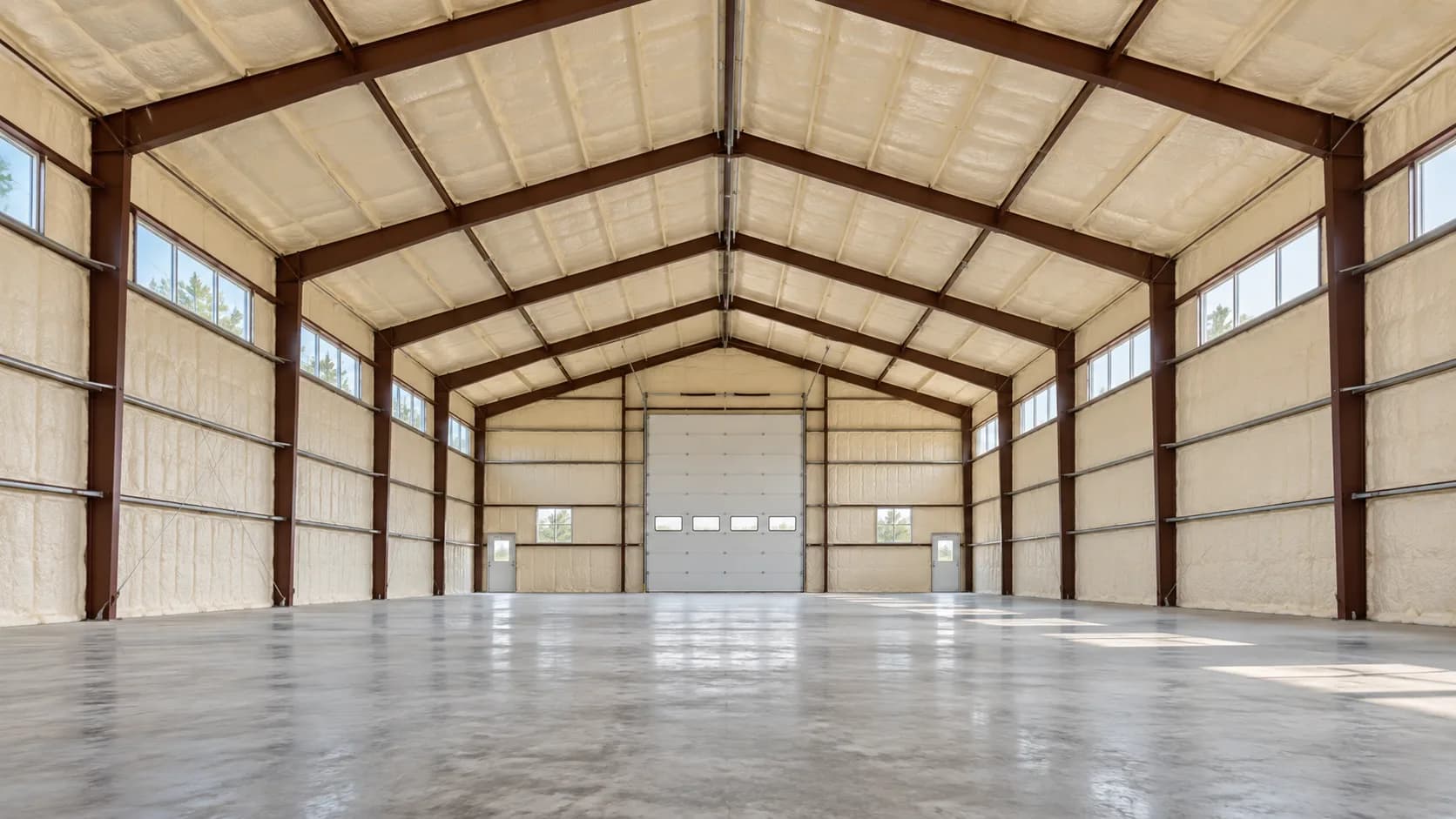
Metal Building Spray Foam Insulation
Shops, garages, warehouses and pole barns across Southeast Texas. Closed-cell foam sprayed right to the steel — priced from your dimensions, usually the same day.
Quick answer
For the metal buildings we work on, we normally recommend closed-cell spray foam applied directly to the wall and roof panels. It insulates, air-seals and — at the right thickness — acts as a vapor retarder in one layer, which helps keep humid Gulf Coast air off cold steel. Send us your length, width and eave height for a price.
A bare metal building in Southeast Texas is an oven in July and a drip pan on a humid morning. Steel panels swing hot and cold fast, and when the inside face of a panel drops below the dew point of the air touching it, water condenses on it — the same way a cold glass sweats. That moisture rusts fasteners, drips onto equipment and soaks whatever is stored below.
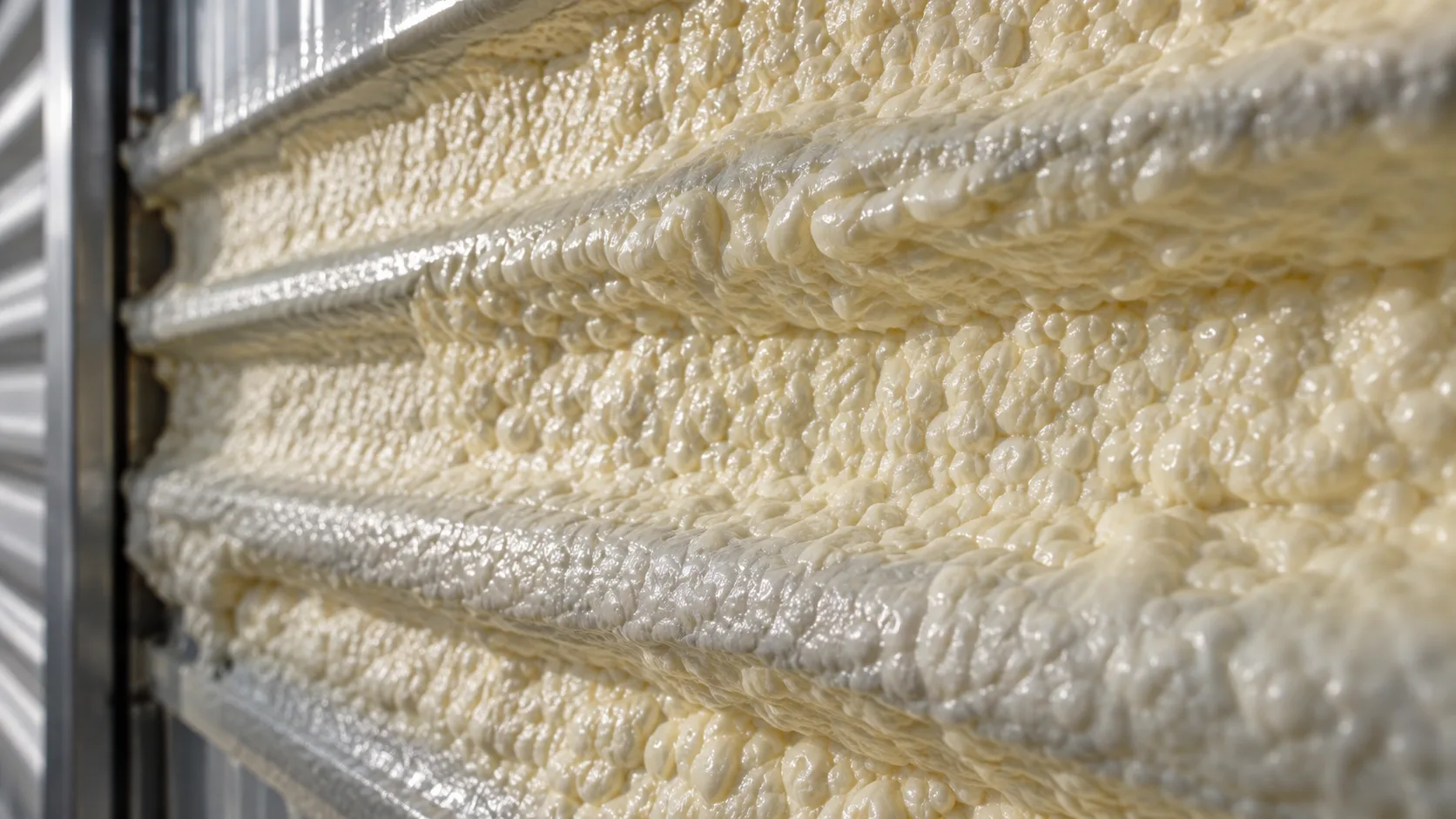
Closed-cell spray foam is the insulation we normally recommend for metal. It bonds to the panels, fills the ribs and seams, and at roughly 1 to 2 inches (depending on the product) becomes a Class II vapor retarder. Done right — with continuous coverage over the purlins, girts and screw tips — it puts insulation, air sealing and moisture control in a single layer.
Most of our customers are finishing a brand-new building and already know they want foam. What they need is a fair number and a crew that shows up when the shell is ready. Send us the length, width and eave height and we can price most buildings without a site visit.
From the owner
For the metal buildings we work on, it’s closed cell. Open cell is softer and cheaper — that’s what you see in a lot of houses — but against steel I want the denser foam that holds up to moisture and gives more R-value per inch.
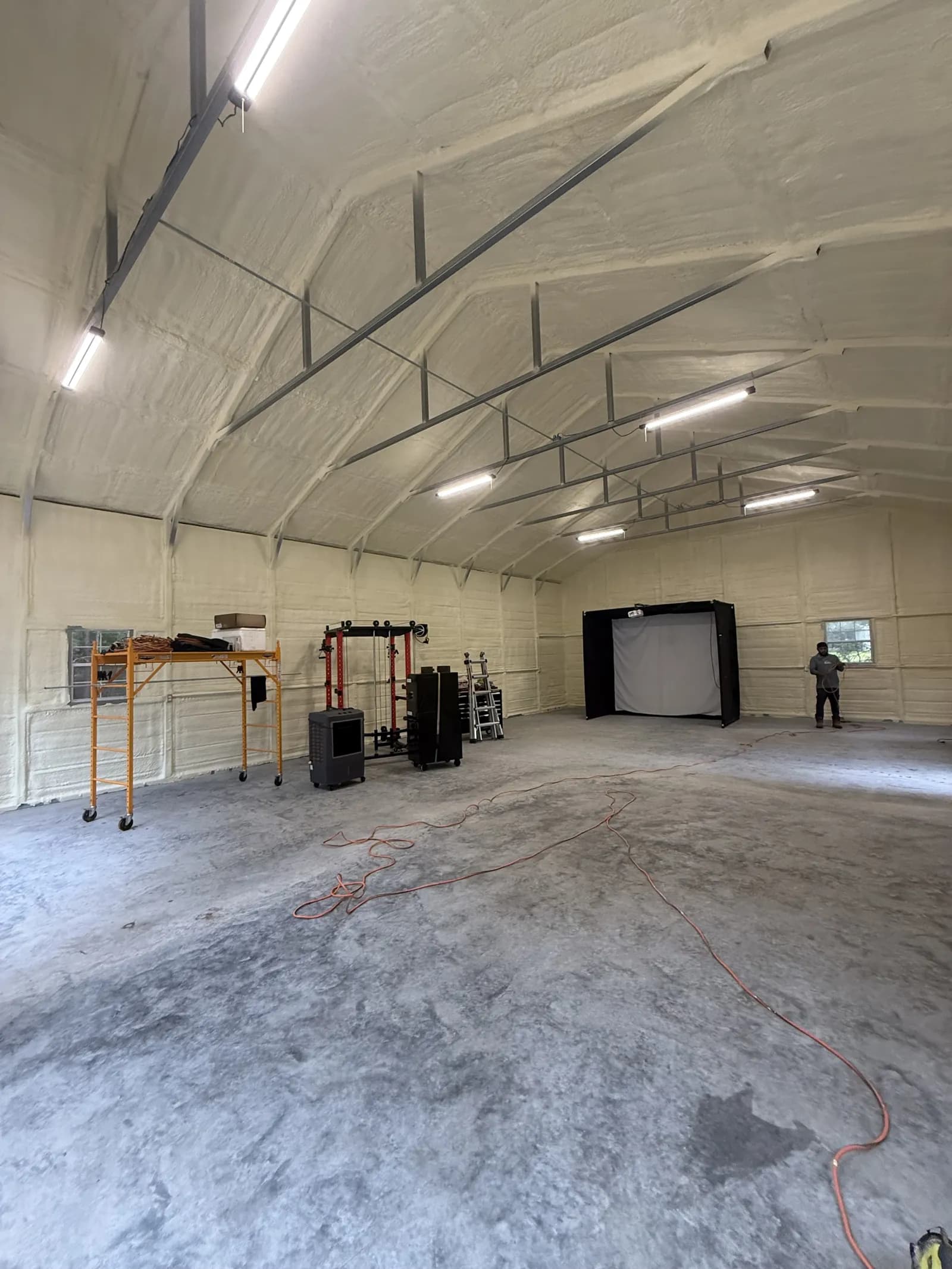
What does metal building spray foam insulation include?
- Wall panels and end walls, including gables
- Underside of the roof panels (between and over purlins)
- Coverage over girts, purlins and screw tips to limit cold spots
- Overhead and roll-up door headers and framed openings
- Masking of windows, doors, slab and equipment before spraying
Why use closed-cell spray foam on a metal building?
Open-cell foam is softer, cheaper and works well in many homes, but it lets water vapor pass through it. Sprayed against cold steel in a humid building, that vapor can reach the panel and condense behind the foam. Building scientists and metal-panel manufacturers point to closed-cell as the usual choice against metal, and that matches what we see in the field.
Closed-cell foam is about four times denser (roughly 2 lb per cubic foot versus about 0.5 lb), doesn’t soak up water, and is rated an acceptable flood damage-resistant insulation in FEMA Technical Bulletin 2 (2025). The exact product and thickness depend on your building and how you’ll use it — we’ll tell you what we recommend and why.
How thick should spray foam be on a metal building?
There’s no single magic number. A shop or storage building insulated mainly to stop condensation and take the edge off the heat commonly gets about 2 inches of closed-cell foam on the walls and 2 to 3 inches on the roof. A building you’ll air-condition as work or living space may need more to meet the energy code where you are. We’ll match the thickness to your goals and budget, and quote both options if you want to compare.
- ▸2 in. closed-cell ≈ R-12 to R-14 (depending on product)
- ▸3 in. closed-cell ≈ R-18 to R-21 (depending on product)
- ▸Applied in passes (lifts) per the manufacturer’s limits so it cures right
Do you spray foam barns and pole barns?
Ag barns, hay and equipment buildings and horse barns get the same closed-cell treatment, sized for how they’re used. Unconditioned barns usually need less foam than a heated-and-cooled shop — the goal is a drier, cooler building that protects what’s inside. High-moisture uses like livestock or wash bays still need ventilation or dehumidification; foam isn’t a substitute for airflow.
What should you know before we spray?
Fix any roof leaks first — foam on the underside of a leaking panel can hide the leak. Check your metal building manufacturer’s panel warranty language about adhered insulation. And if the space will be occupied, exposed foam normally needs a code-approved thermal barrier such as drywall or a listed intumescent coating. We’ll walk you through what applies to your building before you book.
R-values shown are typical ranges for the foam type and thickness stated and vary by product. The higher the R-value, the greater the insulating power. Ask your seller for the fact sheet on R-values. Savings vary. Find out why in the seller’s fact sheet on R-values.
Sources
- U.S. DOE Building America — Which Spray Foam Is Right for You? (PDF)
- Huntsman Building Solutions — BES-102 Design Note: vapor retarder classes (PDF)
- FEMA Technical Bulletin 2 (2025): Flood Damage-Resistant Materials (PDF)
- MBCI — Spray Foam Insulation on Metal Panels
- University of Illinois Extension — Condensation prevention in metal-walled buildings
- FTC R-Value Rule — 16 CFR 460.18
Why it’s worth it
What Spray Foam Does For You
Cooler in summer
Closed-cell foam is typically about R-6 to R-7 per inch depending on the product, and it stops the air leaks around panel laps and eaves that let heat pour in.
Helps stop “sweating”
Continuous closed-cell coverage keeps humid inside air from reaching cold steel — the main cause of condensation drips and rust.
Seals the gaps
Foam fills ribs, laps and eave gaps that batts and blankets leave open, cutting dust, drafts and pests.
Stays put
It adheres to the panel — no sagging blankets, no torn vapor facings, no bubble wrap peeling off the purlins.
Service areas
Metal Building Spray Foam Near You
We spray metal buildings & shops across East and Southeast Texas. Pick your area for local details, or send your building size for a quote.
- Metal Building Spray Foam in Beaumont, TX
- Metal Building Spray Foam in Cleveland, TX
- Metal Building Spray Foam in Dayton, TX
- Metal Building Spray Foam in Montgomery, TX
- Metal Building Spray Foam in Conroe, TX
- Metal Building Spray Foam in Alvin, TX
- Metal Building Spray Foam in Liberty, TX
- Metal Building Spray Foam in Port Arthur, TX
- Metal Building Spray Foam in Livingston, TX
- Metal Building Spray Foam in Huntsville, TX
- Metal Building Spray Foam in Jasper, TX
FAQ
Metal Buildings & Shops FAQ
Don’t see your question? Call or text (346) 505-0304.
How much does it cost to spray foam a metal building?
+
Price is driven by total spray area (walls, gables and roof), foam thickness, access and travel. Send us your length, width and eave height plus your ZIP and we’ll price it — usually the same day. Our cost guide shows the math and typical published ranges, and our price match guarantee covers any lower written quote for the same foam and thickness.
Will spray foam stop my metal building from sweating?
+
Continuous closed-cell coverage at the right thickness greatly reduces condensation risk because humid inside air can no longer reach the cold steel. Any steel left bare — purlins, girts, screw tips — can still sweat, which is why we cover them. High-moisture buildings may also need ventilation or a dehumidifier.
Can you spray foam an existing metal building that already has insulation?
+
Often, yes, but it depends on what’s there. Torn or wet fiberglass blankets usually need to come out first. Spraying over reflective “bubble” insulation is not something we recommend without seeing it, because adhesion and trapped moisture are concerns. Send photos with your dimensions and we’ll tell you the options.
How long does it take?
+
It depends on the size of the building, the foam thickness and the prep involved. We don’t rush it — we take the time to prep, mask and spray in proper passes so it’s done right, and we’ll give you a clear schedule with your quote. Plan to stay out of the building for at least 24 hours afterward, or longer if the foam manufacturer says so.
Do I need anything over the foam afterward?
+
In occupied space, exposed foam normally needs a code-approved thermal barrier — usually ½-inch drywall or a listed intumescent coating rated for that specific foam. Unoccupied storage buildings and barns may be treated differently depending on your jurisdiction. We’ll tell you what applies before we start.
Read before you buy
- How Much Does It Cost to Spray Foam a 40x60 Metal Building? (2026 Texas Guide)
- Closed Cell vs Open Cell Spray Foam on Metal Buildings: Why Open Cell Sweats on Steel
- How Thick Should Spray Foam Be on a Metal Building or Barndo? (R-Value Chart)
- Will Spray Foam Rust My Metal Building or Void the Warranty?
Get Your Spray Foam Price Today
Send your building’s length, width and height. Most quotes back the same day — and we’ll match any lower written quote.